

It’s a crime many of us are guilty of: spoiling our cats (and other pets) rotten! Do you ever get the oh-so-irresistible, sad feline eyes while eating and wonder if you can safely share a treat or two after your meal on occasion? If you are, here are 10 human foods cats can eat that will actually help their health. You can stop feeling guilty now. 🙂
I give you complete permission to spoil them silly. Just don’t overdo the treats. 🙂 Remember: more is not better. If anything, less really is more in this case.
This guide of 10 human foods cats can eat will share with you what you need to know to keep your cat happy, healthy, and safe.
My hope is you will use this as a resource to refer back to any time it’s needed.


* This post may contain affiliate links. Find out more here. Your support keeps the cat-lovin’ content going here at Cat Care Solutions and means more than I can say. Thank you!
10 human foods cats can eat and enjoy with you
While this post serves as a general guide, it is important to establish your cat’s health with your local vet. Each cat has different needs and it’s important to know what those are.
Certain feline conditions including the likes of diabetes, sensitive stomachs, senior kitties, and others will probably require specially formulated foods to maintain optimal health.
Related: 8 Signs of Diabetes in Cats


Meat
I’m betting out of all the foods on this list, meat is the least surprising. It’s no secret that cats are obligate carnivores.
Meat contains most of the essential vitamins and protein a cat needs for optimal health. A diet lacking adequate meat intake could create a deficiency of taurine, vitamin B12, vitamin A, or essential amino acids.
For our cat-kin, this can cause debilitating or life-threatening conditions such as heart, lung, or liver disease to name a few.
We also begin to see signs such as these:
🐾 loss of fur or dullness in color
🐾skin irritations/allergies
🐾problems with hearing and/or eyesight
Human bodies and cat bodies aren’t much different in this way. Even mild deficiencies in certain nutrients can cause major complications.
The most important thing to remember? If you wouldn’t eat it, don’t feed it to your cat. When in doubt, throw it out!
If you could get food poisoning from eating spoiled meat, your cat could get dangerously ill too.
Always serve cooked meat. I know, there are many advocates of a raw meat diet for their felines. I don’t intend to offend anyone with this post.
Advocates for the raw meat diet believe that it most closely resembles a cat’s diet in nature. I understand their reasoning.
I’d rather be safe than sorry, personally. Raw meat contains pathogens that can make you & your cat very sick.
Cooking meat mostly eliminates this risk entirely.
Even the American Veterinary Medical Association (AVMA) recommends against the use of raw meat diets due to their risk of illness and cross-contamination.
The best options for sharing your meaty meal with your feline are:
♥ Boneless, skinless chicken breasts cooked plain with no seasoning
♥ Turkey breast
♥ Beef
♥ High-quality deli meat in small amounts
Raw or cooked bones and fat trimmings are a big no-no and should be avoided!
Bones can pose a real choking hazard for cats. They can also splinter inside a cat’s belly and cause rupture or possibly fatal obstructions.
Fat trimmings (even when cooked) on the other hand are known to cause vomiting, diarrhea, and other intestinal conditions. That makes for one sad kitty!

Fruit
I’m sure you know the saying: “An apple a day keeps the doctor away.”
While this may hold true for us cat parents, apples and some other fruits are also good for cats as the occasional treat.
Fun cat fact: Cats are unable to taste sweetness. A genetic defect in their taste buds is to blame for this anomaly.
Even though our catkin may not be able to taste the sweetness as we do, many still enjoy the texture or smell of certain fruits.
A few benefits of adding the occasional pea-sized amount of fruit to your cat’s diet would include added vitamins, antioxidants, and fiber.
Thankfully, most quality commercial cat food brands have already added in fruits offering the most benefit to your feline.
If you are thinking of feeding fruit as a treat, it’s important to slowly introduce any new foods.
Doing this helps you know if your feline can handle this new food and how much of it. Just because it’s considered “safe,” doesn’t mean it’s good for your cat.
Any sudden changes to your cat’s diet can cause digestive distress, vomiting, and/or diarrhea. Ouch!
Safe fruits for kitties
♥ Apples in very small pieces
♥ Bananas
♥ Blueberries
♥ Peaches
♥ Cantaloupe
♥ Cranberries
♥ Mango
♥ Orange
♥ Pear
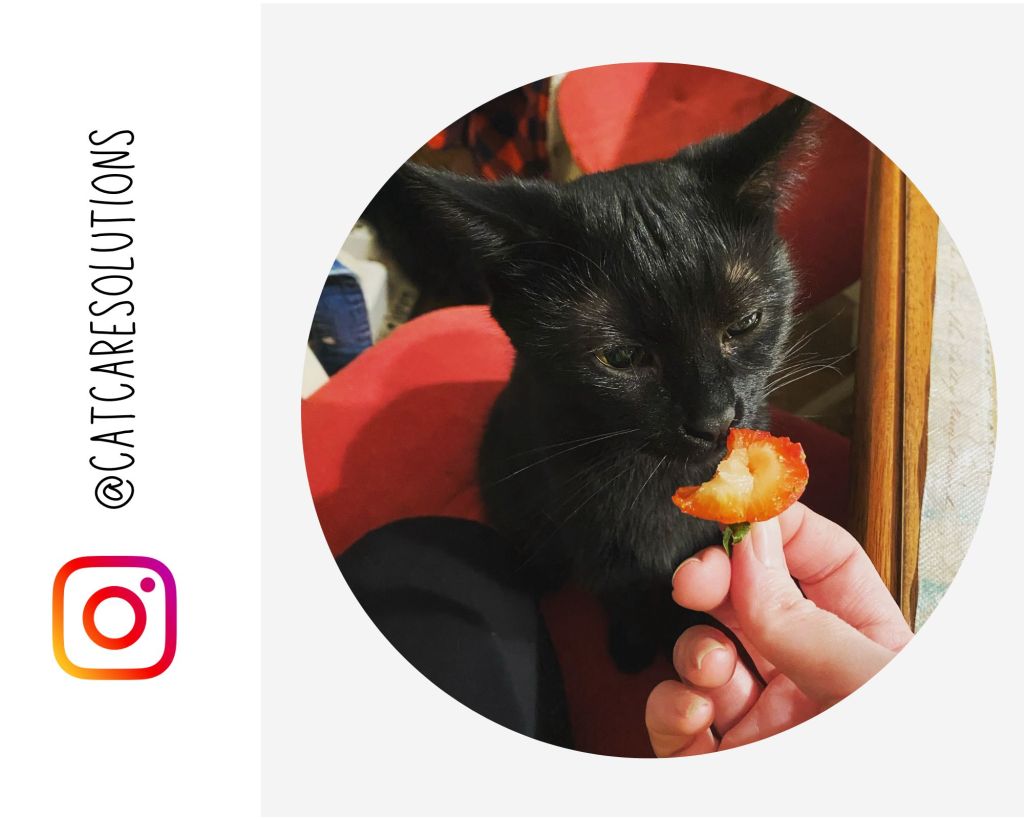
♥ Strawberries
♥ Watermelon
♥ Raspberries
♥ Pineapples
♥ Apricot
Feeding fruit to your cat on a regular basis is not recommended due to high amounts of naturally occurring sugar, which can lead to other health problems.
If you feed your cat any fruit, vegetable, meat, cheese, or other food – please be sure it is cut into very tiny pieces.
toxic fruits for cats
🍇 Grapes (can cause kidney failure)
🐾 Raisins (can cause kidney failure)
🍒 Cherries are highly toxic to cats
🍋 Citrus fruits like lime, orange, lemon, grapefruit, and persimmons
You don’t want feeding a treat to turn into a heartbreaking loss.

Vegetables
If you were one of the millions of kids told to eat your vegetables before your dessert; now you can tell your cat that too!
I’m sure you’ve seen at one time or another, a cat munching on grass.
Cats primarily need roughage for fiber and as an aid in digestion. Their actual need for the nutrients in vegetables is very minimal.
Even though cucumbers and other veggies are considered “safe food” for most cats, some hilariously adorable YouTube videos say otherwise!
Ahhhh! It’s a SNAKE!!

Now that your day has had a little comic relief…
A good reason to add some leafy green goodness into your cat’s diet? If your favorite houseplants seem to be falling victim to your cats, consider adding a small amount of cooked and finely chopped veggies to your cat’s plate. Better yet, grow them their own cat grass.
Personally, I love to grow cat grass indoors. Every time I’ve grown this stuff, my cats have enjoyed every bite.
Cat grass contains a vitamin known as folic acid. This critical vitamin helps your cat’s immune system, keeps the digestive system healthy, and aids in DNA repair, among other functions.
Eating clean, organic cat grass also helps your cat dislodge hairballs. It may not be fun as the cat parent to clean up kitty vomit, but it’s an important part of their well-being.
….now if we could only figure out why they always run to puke on our carpet or right in the walking path.. hmm 🤔
All natural, organic, and non-GMO are our favorites.


The added fiber intake may be just what the doctor ordered.
Related Reading: 10 Completely Safe Houseplants For Cats
Some veggies are lethal to cats
Onions, garlic, and other seasonings are toxic to kitties, so be sure your vegetables are plainly steamed. You’ll avoid the risks and get the benefits.
Safe veggies for cats without seasoning
- Cooked spinach (only if no pre-existing bladder or kidney trouble)
- Steamed broccoli
- Asparagus
- Pumpkin
- Peas
- Green beans
- Cooked and finely chopped carrots
- Zucchini
- Winter squash
- Cucumber
- Bell peppers (red, green, orange, and yellow)
Related: Toxic foods to never feed your cat

Dairy products
Most cats go dairy crazy. We’ve all seen images of happy cats lapping up a delicious bowl of milk or stealing some ice cream. Fish and milk; it’s the “cat stereotype.”
But the truth is, many cats can’t break down and digest the sugar in dairy, called lactose.
What this means for cats or kittens with lactose intolerance is a very upset tummy. Even when we aren’t fully aware of the consequences, this can spell misery for your four-legged best friend.
The older your cat, the more likely it will suffer from worsening lactose intolerance.
The silver lining here is that not all cats are sensitive to dairy products. For kitties who don’t suffer from lactose intolerance symptoms, small amounts of cheese or milk might be just fine. Know your cat and what they can safely have.
Some healthy choices for a cheesy cat treat would be a low-lactose variety:
♥ Swiss
♥ Cheddar
♥ Cottage cheese
♥ Parmesan
♥ Plain yogurt is another option you might consider. The added probiotics can be very beneficial for your cat’s gut health.
One or two tablespoons is more than enough. Our girls, Rascal and Beanie, look forward to their scoop of plain full-fat greek yogurt every day! It has helped Rascal’s digestion a lot.
Please be sure there are no added sugars, flavors, or additional ingredients as this can be very dangerous for kitty. For example, an artificial sweetener found in many foods, xylitol, is highly toxic/deadly for cats when consumed.

Some grains
My husband Bill rescued a very malnourished feral kitten named Kat. She loved corn on the cob! He would bring it into the house and before you knew it, Kat had devoured a couple of ears of corn.
The evidence was all over the floor! He couldn’t keep it in the house without her going wild about it.
Kat wasn’t alone. Many cats love corn and other whole grains. Even though they don’t enjoy the sweetness as we do, they still love the texture and smells.
It is worth noting that of all possible food allergens for cats, corn ranks as the least likely to cause an issue. Most commercial pet food, unless specified grain free, will contain corn to complete the nutrient profile.
A study done by Veterinary Dermatology discovered out of 56 cats participating, only four were allergic to corn. Contrast that to the 45 cats who suffered from fish, beef, and dairy allergy! That’s quite a contrast, isn’t it?
It just goes to show that we can’t automatically assume we know what is right for our cat’s health.
Instead, we need to take notice of their individual condition, seek medical advice from our local vets and make adjustments when our feline isn’t acting like him or herself.
We are unique in our physical needs. Our cats are too.
A mistake many well-meaning cat parents make is to assume what’s bad for them is bad for their cat too. Not always.
Gluten/ grain free, vegan and raw meat diets can all negatively impact the health of your feline if these dietary restrictions aren’t medically necessary.
If blood work has determined your cat has a food allergy, consider adding a nutritional supplement to make up for what they lack in their diet.
Safe grains for kitties
♥ Cooked corn
♥ Couscous or millet seems to be a cat favorite
♥ Mashed sweet potatoes
♥ Breadcrumbs
♥ Plain oatmeal

The incredible edible egg
This heart-healthy, protein-packed super-food has become the quintessential breakfast choice for many people. If you are anything like us, it’s great for any meal of the day. For all of you bakers out there, you know the delicious treats eggs can help make.
No wonder these little gems claimed titles like, “The incredible edible egg,” or “The almighty egg.”
This nutrient-dense food is not only a healthy option for us, but it is safe for your cat also. In fact, there are medical reasons to recommend them.
When cooked properly, eggs provide protein easily digestible for your kitty. High amounts of amino acids also help protect their muscular health for lean, strong bodies ready to take on the kitty kingdom!
We all know this is the cat’s world and we are just privileged to share it with them. They don’t even try to keep this one a secret!
Recently a family member’s cat, Trixie, was suffering from very poor health. A mysterious tummy trouble was creating a situation where Trixie had no desire to eat.
When she did, she would get very sick. This never-ending cycle was creating increasingly poor health and it was feared she would soon need to be helped to the rainbow bridge.
Being a farmer for over 60 years, my family member decided to give Trixie some cooked eggs. This was the only food she was able to eat and it kept her alive, in reasonably good health, for just over another year.
Eggs really can do wonderful things for your cat’s health. They are naturally high in taurine, a critical amino acid for many of the most basic functions in a cat’s body.
Moderation is the key. 1 egg equals 90 to 100 calories, making this a very calorie-dense food. On average, most healthy and active cats only need around 200 to 300 total calories per day.
Curious how many calories your cat needs to maintain optimal health? Have a look at this calorie calculator for cat health
Important note: Please do not feed raw eggs to your cat. They contain harmful bacteria and a protein called avidin. Avidin can block the absorption of vitamin B and cause major health problems. Please consult with your own vet for best results!

Fish
Let me bust a big myth here…Not all kitties like fish!
My “Shug” would gag even at the smell of fish. She was having no part of it! I must admit, the hubs and I share her aversion. 😲
Quality fish, though, does have amazing health benefits.
Omega 3’s are the primary reason fish is such a healthy food. Omega 3’s protect our brain, eyes, and joints, plus reduce our heart disease risks and so much more!
When it comes to our furry feline friends, it turns out Omega 3’s are just as beneficial. Omega 3 fatty acids create shiny, healthy fur and protect those beautiful ‘peepers!’
We have used the Nordic Naturals brand with good success. Our cat Dizzy lost her fur and had itchy irritated skin. She gets can food twice a day so we began adding a few drops of this to her food with each serving. Within a few weeks, her fur began to grow back, her skin wasn’t nearly as itchy, and she seemed to be in much less discomfort overall. She also seemed to enjoy the taste of this supplement which made for easy dosing! ⬇️


Raw fish is the only exception to this fishy rule. A diet for cats with raw fish can create a B1 deficiency, also known as thiamine.
Thiamine is responsible for many of the critical functions in your cat’s body.
When thiamine levels become too low, there are severe consequences like stomach pain, weight loss, neurological issues, and weakness. Extreme cases can even cause heart failure.
Another primary concern when feeding fish to your cat is toxic levels of mercury and magnesium building up in their blood. Curious about which fish are safe for cats? You’ll want to read this post next ➡️ Can Cats Eat Canned Tuna? Here’s What You Need to Know to Keep Them Safe


Oatmeal
Hooray for oatmeal! Not everyone enjoys the texture or taste of this food choice, but if you are someone who does love this nutrient-dense food, I’ve got good news!
You and your cat can enjoy breakfast (or dinner) together!
Oatmeal is rich in vitamin B. Vitamin B12 for example is crucial to the health of your cat’s immune system, nervous system, and digestive tract.
Your cat may not go wild over oatmeal, but hey, it’s worth a try right? You might find a new way to make your purring pal happy! I’d say that calls for a long cat nap in the sunshine! What say you?
Just remember – formulated for health cat food is the most important ingredient your cat needs. These tasty treats are just that… treats.
When feeding your cat oatmeal, there are a few important things to keep in mind, however.
“When it comes to feeding oatmeal to your cat, make sure you cook it for a few minutes or pre-soak your oats overnight in water. And only ever offer them a small amount as a treat or, alternatively, you can try mixing a small amount of oats with their wet food. Also, make sure you only ever serve the oatmeal plain, and don’t ever add any toppings such as sugar or cinnamon,” the experts from Purina explain.

Baby food
That’s right, some baby foods are safe for your cat too! I guess that’s further proof of how much our cats are our babies!
In fact, there are some medical reasons this food choice would be beneficial. Though it is great for emergencies, a regular diet of baby food is not typically recommended.
Senior cats, sick cats, and stubborn cats who need to take medication are all great reasons to feed baby food.
Added ingredients can seriously harm or kill your cat. Carefully check labels for ingredients on the do not feed list.
If your baby food has any of these ingredients, please do not feed it to your four-legged baby:
- Onions
- Garlic
- Salt
- Any added sugar or sweeteners of any kind
- Milk (dairy products)
- Oils
- Fruits or vegetables (because not all are safe!)
- Cornstarch IF your cat is diabetic
The general safe rule of thumb is to consider options with only a few ingredients such as pureed meats and water. Cornstarch is generally considered safe if your cat is not diabetic.
A little goes a very long way. 1 teaspoon or tablespoon is a great start. 🐾
Check for this Gerber product in your local store or see it online. It has only 3 ingredients: ground chicken, water, and cornstarch.


♥ Pasta!
I kind of chuckled when I read this as my imagination went to an Italian-speaking cat who couldn’t live without their pasta and works pure cat magic with it! 🙂
Next time you’re cooking up some plain spaghetti noodles and feel like sharing, you can! Just make sure it is a tiny amount.
Pasta is loaded with carbohydrates and can cause feline obesity and other digestion distress.
It is also possible for your cat to be gluten intolerant. This could make your cat’s stomach do back flips and nobody likes that, now do we?
Related: Symptoms of wheat allergy in cats


♥ Whole Grain Bread (in small amounts)
Here at our home, we feed a lot of feral kitties. Apparently, the word is out that total softies for animals live here and will keep their tummies full. We sure would love for them to have their forever homes!
Here are two of the brothers sunning themselves on our deck. Aren’t they adorable? Those are some happy faces!
We call them “Big Man” and “Lil’ Man.” Big Man is the cutie with more white and Lil Man is our “ginger tux.” 😻


It turns out that one of the ferals really likes bread, a lot. She’s a glutton for it.
I have often wondered, “Is this safe?” Thankfully, it is. Much like pasta – unless your kiddo has a gluten allergy, small amounts of bread are perfectly okay to share.
Whole grain breads are preferred over white bread for their nutritional benefits.
I wouldn’t recommend feeding bread as a regular snack in your cat’s diet, though. In the same way large amounts of bread for us can cause weight gain and other health problems – the same is true for our cats.
Conclusion
These 10 human foods cats can eat is obviously not a complete list but I do hope that it has eased your mind about giving your feline best friend a treat now & then.
To recap, here are a few important things to remember:
- Seasonings like onions, garlic, and other herbs can be deadly for your cat. Keep food simple; plain, steamed, or unseasoned when sharing.
- Some cats eat milk and cheese without a problem but many (if not most) have trouble digesting lactose, the sugar found in dairy. Try small amounts to test for intolerance or consider low-lactose cheese for treats.
- Certain types of fish have great health benefits for cats, but some fish are safer than others due to high mercury levels
- Growing cat grass not only satisfies your cat’s need for fiber, but it helps them with digestion, immune function, and gives them nutrients like vegetables do for us.
- Human foods don’t contain all of the nutrients our cats need for optimal health. It’s fine for treats, but keep them to a minimum. Follow the 90/10 rule. This means only about 10 to 15% of your feline’s calories should come from treats. 85-90% should come from specifically formulated cat food, wet or dry.
Has this helped you in any way? Did I miss anything important? I’d really love to hear your thoughts in the comments below.
If you have found this guide to be thoughtful and useful, please be sure to share it with your social media family. Your support is such an encouragement to me.
Everything I do or write here at Cat Care Solutions is done with the aim of helping others. I believe that’s what life is really all about.
Pet parenting is a fun challenge and there is always something new to learn! They sure do keep us on our toes, don’t they?
Does your cat have a favorite treat you love to share with them? Please tell me all about it in the comments below!
All My Love & Healing Purrs To You & Yours,

